
You press the button and nothing happens. The window is stuck, the rain is coming, and you need the car tomorrow morning.
Power window repair usually comes down to the window regulator or its motor. Our shop checks the switch, wiring, regulator, and motor in that order, finds the failed part fast, and fixes it the same day in most cases.
Most drivers blame the switch first, but the switch is often innocent. Here is how we find the real cause and get your window moving again.
What Is a Window Regulator and Why Does It Fail?
The window works every day for years, and then one morning it stops halfway. That part has a name, and it fails more often than anything else in the door.
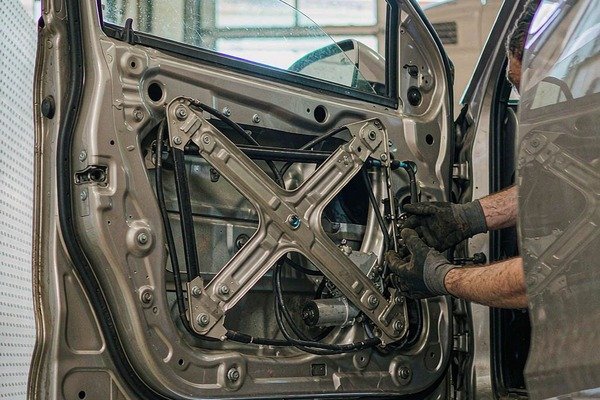
A window regulator is the mechanism inside the door that raises and lowers the glass. It works together with an electric motor, and worn cables, bent tracks, or a burnt-out motor are the most common reasons a window stops moving.
Which part actually broke?
A power window[1] is a small system, not one part. The switch sends the signal, the wiring carries the power, the motor spins, and the regulator turns that spin into glass movement. So we test each link in that chain. A click with no movement points to the motor or regulator. A dead switch on one door points to that switch. Dead windows on every door point to a fuse or ground. This order saves money, because a new motor will not fix a broken switch, and a new regulator cannot help a blown fuse.
| Part | What it does | Typical failure sign |
|---|---|---|
| Regulator | Raises and lowers the glass | Grinding, crooked glass, glass that drops |
| Motor | Powers the regulator | Click sound but no movement, slow travel |
| Switch | Sends the up and down signal | One door dead, other doors fine |
| Wiring and fuse | Delivers power to the system | Every window dead, intermittent operation |
Which Power Window Problems Do We Fix?
Some shops only swap regulators. We repair the whole window system, because the regulator is just one of the parts that fails.
We repair stuck windows, slow-rolling windows, glass that has jumped off its track, malfunctioning switches, broken buttons, windows that will not go up, windows that will not go down, and intermittent operation, on power and manual regulators alike.
What does each symptom usually mean?
Each problem has a short list of likely causes, and experience narrows it fast. A stuck window with no sound is electrical. A slow window is mechanical, because the motor still works but the regulator drags. Crooked glass or glass that fell into the door has jumped its track, so we reseat it and replace the broken clips or regulator. Intermittent operation usually comes from tired motor brushes or a loose connector. We also repair manual window regulators, where a stripped crank, worn cable, or bent handle is the culprit instead of a motor.
| Symptom | Likely cause | Typical fix |
|---|---|---|
| Window stuck, no sound | Switch, wiring, or fuse | Electrical diagnosis, then the failed part |
| Window rolls slowly | Worn regulator or binding track | Regulator service or replacement |
| Glass off track | Broken clips or failed regulator | Reseat the glass, replace clips or regulator |
| Button or switch dead | Worn switch assembly | Switch replacement |
| Moves one way only | Faulty switch or relay | Switch or relay replacement |
| Works sometimes only | Loose connector, tired motor | Circuit trace, motor repair or replacement |
How Fast Is the Repair?
A dead window is more than an annoyance. It leaves your car open to rain and theft, so speed matters.
Most power window repairs are same-day work. We diagnose the fault first, quote the price before we touch anything, and finish most regulator repairs and replacements in a single visit.!
Why do we test the window after the repair?
Diagnosis first, parts second. That order saves you money and catches the small stuff. After the repair, we run full up and down cycles and check the safety features. Modern cars use anti-pinch auto-reverse windows, and federal rules for power-operated window systems[2] govern how they close. NHTSA also advises drivers to use the power window lock switch[3] around children, because kids can lean on switches and trigger a closing window. If your rear windows mysteriously stop working, check that lock switch before you call us. It might just be doing its job.
Conclusion
Most power window failures trace back to the regulator or its motor, and a proper diagnosis finds the real culprit before any part gets replaced. We fix stuck, slow, off-track, and dead windows the same day, and we test every window before you drive away.
References
Wikipedia — Overview of power windows, how the regulator and motor system works, and its history in modern vehicles. ↑ Back
Electronic Code of Federal Regulations — Federal Motor Vehicle Safety Standard No. 118, the federal standard governing power-operated window systems. ↑ Back
NHTSA — Child safety guidance on power windows, including the window lock switch, pull-to-close switches, and auto-reverse systems. ↑ Back